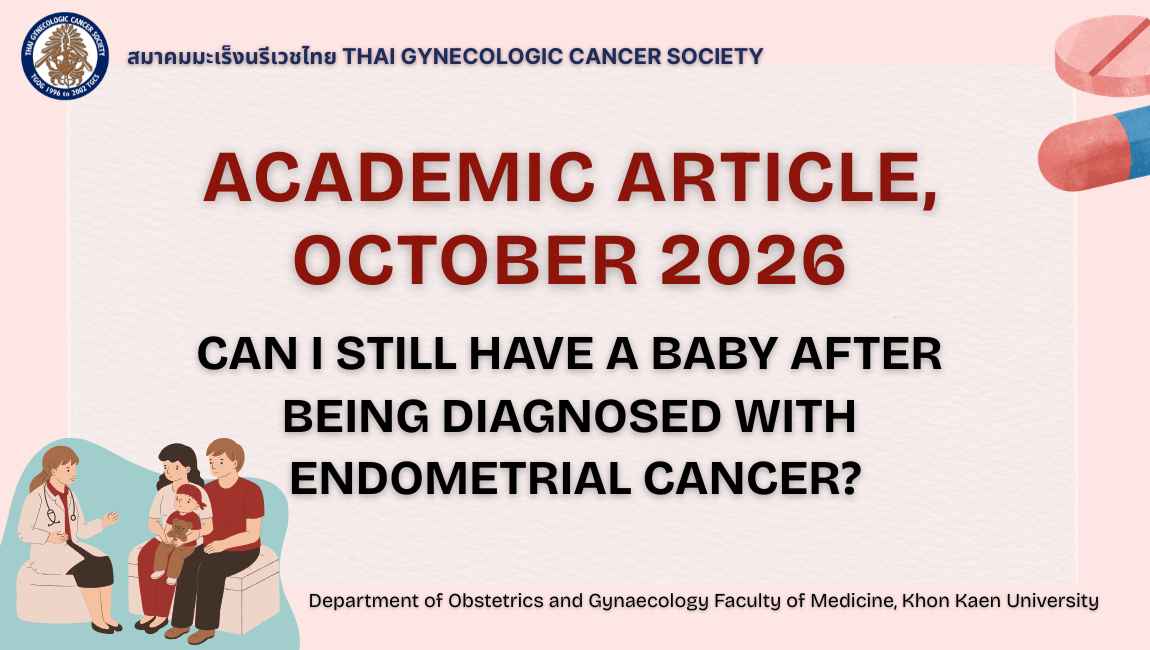
Can I Still Have a Baby After Being Diagnosed with Endometrial Cancer?
Asst. Prof. Naratassapol Likitdee, MD, MMEd
Department of Obstetrics and GynaecologyFaculty of Medicine, Khon Kaen University
The answer is it may be possible for some patients. Endometrial cancer is increasingly being diagnosed in women under the age of 50. For some younger women, a diagnosis of endometrial cancer does not necessarily mean losing the uterus and the possibility of becoming pregnant. The challenge is to strike the right balance between cancer safety and preserving fertility. Several important factors need to be considered.
1. What should be considered before deciding to preserve the uterus?
First, we need to be certain about the type and stage of the cancer
Your doctor may recommend hysteroscopy to examine the inside of the uterus and take a biopsy directly from any suspicious areas (hysteroscopy-guided biopsy). This may improve the accuracy of tissue sampling because the abnormal area can be seen during the procedure. The biopsy findings should also be confirmed by an experienced pathologist.
Assess the chances of becoming pregnant
Before choosing fertility-sparing treatment, the likelihood of achieving a pregnancy should also be assessed. This allows patients to make informed decisions about both their cancer treatment and their plans for having children in the future. Assessment may include evaluating ovarian function and, where relevant, semen analysis for the male partner. Early consultation with a fertility specialist is also recommended.
Look after your health to improve the chances of pregnancy
For patients living with obesity, weight loss and good blood sugar control may help improve the chances of pregnancy and reduce the risk of the cancer returning. Lifestyle changes should therefore form part of the overall treatment plan.
What should you know before making a decision?
Patients should be aware that fertility-sparing treatment is an option for carefully selected patients with endometrial cancer and requires close, long-term follow-up. Once childbearing has been completed, definitive surgery for the cancer is recommended.
2. Who may be able to preserve their uterus?
In general, fertility-sparing treatment may be considered for patients with low-risk cancer at a very early stage. The cancer should still be confined to the lining of the uterus, with no invasion into the muscle of the uterus and no evidence that the cancer has spread outside the uterus.
3. If the uterus is preserved, what treatment options are available?
-
Continuous treatment with the hormone progestin, which may be given through a hormone-releasing intrauterine device or as oral medication.
-
Hysteroscopic assessment and removal of the abnormal tissue.
-
A combination of oral progestin and a hormone-releasing intrauterine device.
-
Advice and support with weight management and lifestyle changes to help improve the chances of pregnancy and reduce the risk of the cancer returning.
4. What follow-up is needed after treatment?
Most importantly, preserving the uterus does not mean that the cancer has been cured. Regular follow-up is essential, with assessment of the lining of the uterus every 3–6 months. This may involve hysteroscopy, dilation and curettage, or an endometrial biopsy.
Once the cancer has responded to treatment, patients should discuss plans for pregnancy with their doctor without unnecessary delay. Follow-up should continue, including assessment and biopsy of the endometrium every 6–12 months. Once childbearing has been completed, or if the cancer progresses, definitive surgery for the cancer is recommended.
However, if cancer is still present at the 6-month follow-up, combined progestin treatment may be considered if it has not already been used. If cancer is still present at 12 months, definitive surgery for the cancer is recommended.
Preserving the uterus may be possible, but safety comes first
Fertility-sparing treatment can therefore be an option for some patients with endometrial cancer, particularly younger patients who wish to have children. However, it is not suitable for everyone. The decision should take into account the characteristics of the cancer, the likelihood of achieving a pregnancy, and the patient’s ability to attend close follow-up. Ultimately, the decision should be made jointly by the patient and their healthcare team.
เอกสารอ้างอิง
-
Peeri NC, Bertrand KA, Na R, et al. Understanding risk factors for endometrial cancer in young women. J Natl Cancer Inst. 2025;117(1):76-88.
-
Rodolakis A, Scambia G, Planchamp F, et al. ESGO/ESHRE/ESGE Guidelines for the fertility-sparing treatment of patients with endometrial carcinoma. Hum Reprod Open. 2023;2023(1):hoac
-
National Comprehensive Cancer Network. NCCN Clinical Practice Guidelines in Oncology: Uterine Neoplasms. Version 3.2026. 2026. https://www.nccn.org.
-
Catena U, Macklon KLT, Rodolakis A, Scambia G. A practical guideline on the fertility-sparing treatment of patients with endometrial carcinoma and atypical endometrial hyperplasia. Int J Gynaecol Obstet. 2025;169(2):453-455.