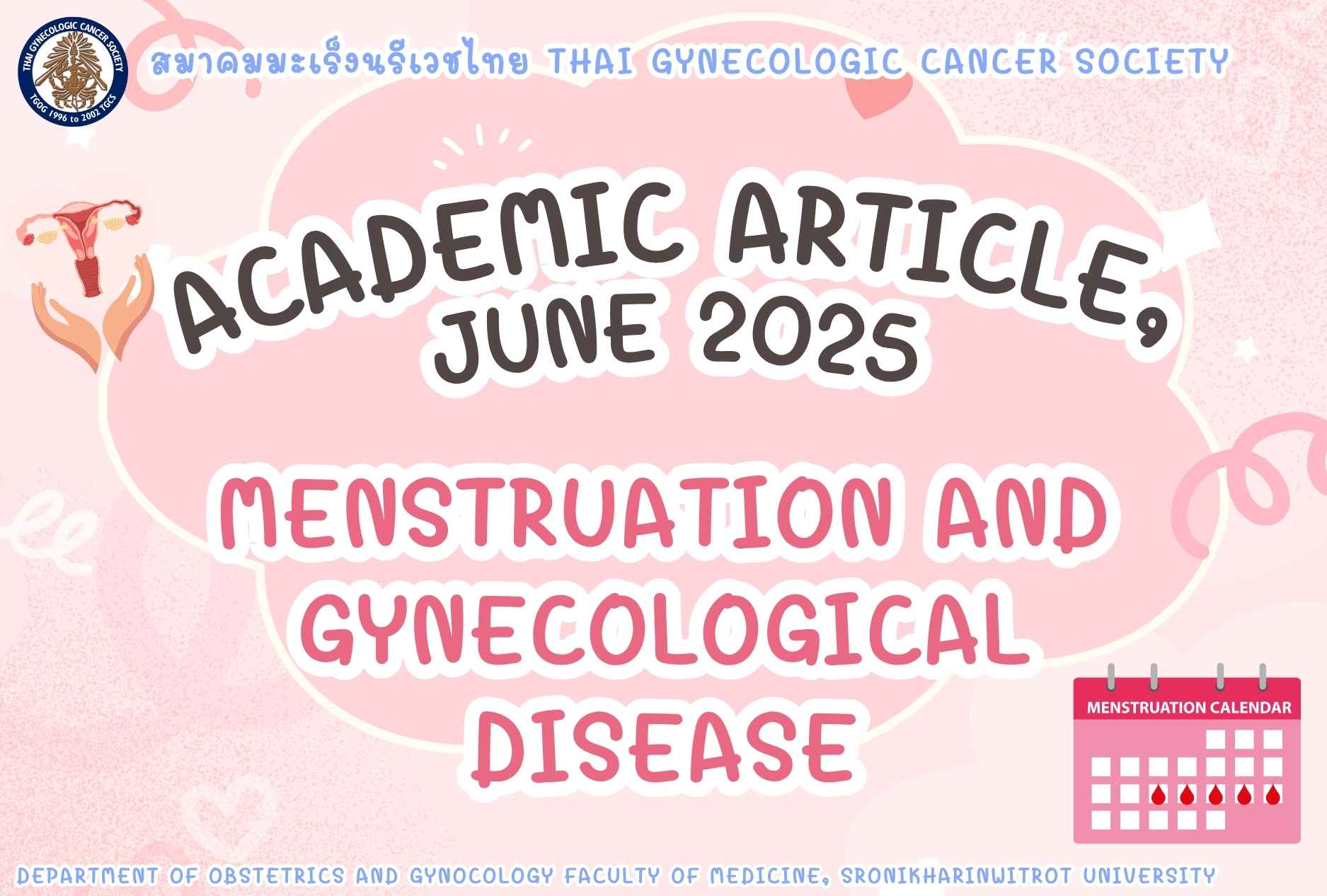
Academic articles, June
Menstruation and Gynecological disease
Assoc. Prof. Suttha Hamontri
Assoc. Prof. Tanitra Tantitamit
Department of Obstetrics and Gynocology
Faculty of medicine, Sronikharinwitrot University
Menstruation is a normal physiology for reproductive age women. When a woman notices a change in her usual menstrual pattern, it can cause concern about an underlying condition, including anxiety about potential cancer. Therefore, it is important to first understand the characteristics of normal menstruation.
Previous studies in the Thai population indicate an average menarcheal age of 11.5 years(1) and a menopausal age of 49.5 years(2), with recognized individual variations. Menstruation is regulated by ovarian hormone production. The ovaries, containing female reproductive cells, mature and release an egg during each menstrual cycle. Key hormones, estrogen and progesterone, prepare the uterine lining for potential embryo implantation. If fertilization and implantation do not occur in an ovulatory cycle, the uterine lining sheds as menstrual blood, initiating the next cycle of egg maturation.
Normal menstruation is characterized by a cycle length of 21 to 35 days (averaging 28-30 days) and bleeding that typically lasts 2 to 6 days. While average blood loss per cycle ranges from 20 to 60 milliliters(3), accurately measuring this volume in practice remains challenging.
Menstrual patterns can change due to the use of hormonal contraceptives, as follows:
Oral Contraceptive Pills (OCPs): In Thailand, most available OCPs are combined hormonal pills (estrogen and progesterone) with fixed hormone doses, typically sold in 21- or 28-tablet packs. Menstrual bleeding is controlled by the hormones in the pills. Most users experience regular periods according to the pill cycle. However, in some cases, amenorrhea (absence of menstruation) may occur despite consistent pill use.
Contraceptive Injections: Injectable contraceptives available in Thailand belong to the progesterone group and are administered every 3 months. After injection, menstrual patterns can change, such as irregular bleeding (spotting) that may be light or heavy, or even complete amenorrhea after a period of use.
Contraceptive Implants: Currently available implants contain progesterone in single or double rod forms. They provide contraception for 3 or 5 years, depending on the type of implant. After insertion, menstrual patterns can vary significantly, including reduced or increased menstrual volume with consistent intervals, irregular spotting, or amenorrhea.
Contraceptive Patches: This method involves a hormone patch applied to the skin, allowing both estrogen and progesterone to be absorbed transdermally. One box typically contains three patches, applied one per week for 3 consecutive weeks, followed by a patch-free week before the next cycle. Menstrual bleeding usually occurs during the patch-free week. Menstrual volume may change.
Emergency Contraceptive Pills (ECPs): These oral contraceptives are intended for urgent situations, such as when other birth control methods fail or are used incorrectly (e.g., condom breakage). ECPs often cause irregular bleeding or spotting after use.
Therefore, if menstrual bleeding becomes abnormal or changes in a way that causes concern while using contraceptives, it is advisable to consult a doctor to determine the cause and appropriate treatment.
Abnormal Menstruation and Gynaecological Cancers
Abnormal menstrual bleeding that cannot be explained often causes anxiety, leading to concerns about underlying conditions, including the fear of cancer. It is important to be aware of menstrual characteristics that may be associated with various types of gynecological cancers:
Cervical Cancer and Vaginal Cancer(4): These typically manifest as abnormal vaginal bleeding. In the early stages, when lesions are small, the primary symptom is post-coital bleeding. As the disease progresses and lesions enlarge, there may be blood-tinged discharge appearing brownish, or noticeable irregular bleeding that varies in volume. This may be accompanied by foul-smelling vaginal discharge.
Endometrial Cancer(5): Symptoms include blood-tinged discharge or abnormal irregular bleeding during perimenopause or after menopause. The amount of bleeding can vary from minimal to heavy. This also applies to reproductive-aged women at higher risk, such as those who are overweight, have anovulation, or have a family history of endometrial cancer.
Ovarian Cancer(6): This cancer generally does not present with abnormal vaginal bleeding. However, a very small minority of cases may experience abnormal bleeding, particularly with hormone-producing ovarian cancers, which can occur even in childhood. Therefore, any abnormality should prompt medical consultation.
Choriocarcinoma(6,7): Possible symptoms include unexplained abnormal bleeding after childbirth or miscarriage.
Vulvar Cancer(8): Symptoms may include irregular bleeding unrelated to the menstrual cycle, along with the presence of itchy lesions, bleeding, or growing lumps in the external genitalia or groin area.
However, most causes of abnormal bleeding or menstrual irregularities are not due to cancer. Nevertheless, it is crucial to consult and be examined by a specialist physician to determine the underlying cause of any abnormality. Information that should be prepared for the doctor to aid in diagnosis includes:
Characteristics of normal menstrual cycles: regular interval, duration of bleeding, characteristics of menstrual blood, volume of sanitary pad use, age at menarche, and age at last menstruation.
Characteristics of the most recent and previous menstrual cycles that have been recorded: start date, duration, any deviations from normal, abnormal vaginal discharge, or irregular bleeding between cycles.
History of contraceptive use, miscarriage, and childbirth.
References
ปังปอนด์ รักอำนวยกิจ, ธนินี สหกิจรุ่งเรือง, คมศักดิ์ ศรีลัญฉกร, อัครนัย ขวัญอยู่. โครงการศึกษาสถานการณ์ การเป็นสาวก่อนวัยของเด็กไทย ( A study of the female precocious puberty in Thailand) วิทยาลัยประชากรศาสตร์ จุฬาลงกรณ์มหาวิทยาลัย 2562
Chompootweep S, Tankeyoon M, Yamarat K, Poomsuwan P, Dusitsin N. The menopausal age and climacteric complaints in Thai women in Bangkok. Maturitas 1993;17: 63-71.
Vollman RF. The menstrual cycle. In : Friedman E, ed. Major Problems in Obstetrics and Gynecology. Philadelphia, PA: Saunders, 1977: 1-193.
Mwaka AD, Okello ES, Wabinga H, Walter Symptomatic presentation with cervical cancer in Uganda: a qualitative study assessing the pathways to diagnosis in a low-income country. BMC Womens Health 2015; 15: 15.
Amant F, Moerman P, Neven P, Timmerman D, Limbergen EV, Vergote Endometrial cancer. Lancet 2005; 366:491-505.
Adams T, Denny L. Abnormal vaginal bleeding in women with gynaecological malignancies. Best Pract Res Clin Obstet Gynaecol 2017; 40:134-47.
Berkowitz RS, Horowitz NS, Goldstein DP. Gestational trophoblastic disease. In: Berek JS, Berek D, editors. Berek&Novak’s Gynecology. 16th Wolters Kluwer; 2020. p. 1170-85.
Merlo S, Modern Treatment of Vulvar Cancer. Radiol Oncol 2020;54(4):371-6.