Academic Article, September 2026
Palliative Care in Gynecologic Cancer
Integrating symptom relief and quality of life throughout the cancer journey
Napas Lohtrakul, MD
Department of Obstetrics and Gynecology, Phramongkutklao Hospital
Advances in gynecologic oncology have expanded therapeutic options and prolonged survival, but more treatment does not automatically reduce symptom burden or decisional burden. Patients may experience pain, malignant ascites, nausea, bowel obstruction, bleeding, lymphedema, fatigue, altered body image, sexual-health concerns, financial strain, and caregiver distress. Integrating palliative care with oncology is therefore a component of high-quality cancer care, not a service reserved for the point at which disease-directed treatment ends.
What Is Palliative Care?
The World Health Organization defines palliative care as an approach that improves the quality of life of patients and families facing life-threatening illness through early identification, assessment, and treatment of physical, psychosocial, and spiritual problems (1). In oncology, its core functions also include building therapeutic relationships, supporting illness understanding and coping, communicating about prognosis, clarifying treatment goals, assisting medical decisions, coordinating care, and supporting caregivers (2).
Palliative care can be delivered at two complementary levels. Primary palliative care comprises core skills that oncology teams should provide, including routine symptom screening, first-line symptom management, and basic goals-of-care communication. Specialist palliative care adds interdisciplinary expertise for complex or refractory symptoms, multidimensional distress, challenging decisions, or substantial caregiver needs. Referral expands the care team; it does not replace the gynecologic oncologists.
How Is Palliative Care Different from Hospice?
Palliative care is needs-based and may begin at any stage of a serious illness while surgery, systemic therapy, radiotherapy, or other disease-directed treatment continues. Hospice is a model of care for people approaching the end of life, when the principal focus has shifted toward comfort and quality of remaining life rather than disease modification (3). End-of-life care is consequently part of the broader palliative-care continuum, but the terms are not interchangeable. Hospice eligibility, financing, and service models differ across health systems; the six-month prognosis criterion used in parts of the United States should not be treated as a universal definition or a referral threshold in Thailand.
What Is Early Integrated Palliative Care?
Early integrated palliative care introduces palliative assessment and intervention early in advanced illness while active anticancer treatment continues. The 2024 (American Society of Clinical Oncology, ASCO) guideline strongly recommends, on moderate-quality evidence, that patients with advanced solid tumors be referred early to interdisciplinary specialist palliative-care teams with outpatient and inpatient availability alongside active cancer treatment (2). The update does not impose a single time point for every patient; it particularly emphasizes early involvement for uncontrolled symptoms or quality-of-life concerns (4).
Where specialist capacity is limited, a tiered, needs-based model is pragmatic: oncology teams provide primary palliative care, routinely screen patient-reported symptoms and distress, and refer those with complex needs. Prognosis alone should not function as the gatekeeper.
Goals-of-care conversations should begin with what the patient understands, values, hopes for, fears, and considers an acceptable outcome, then connect treatment information to those priorities. Advance care planning is a longitudinal, revisable conversation—not a one-time form.
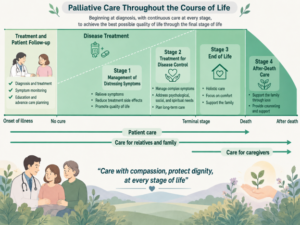
Figure 1. Continuum of patient care from diagnosis through the end of life. Adapted from Darin Jaturapatporn and Chidchanok Chuchuay. Palliative Care: Caring with Compassion, Parting with Love. 3rd ed. Bangkok: Amarin Health; 2025. Illustration created using ChatGPT (OpenAI).
What Benefits Are Supported by Evidence?
The 2024 ASCO update identified 52 studies informing its recommendations and reaffirmed early integration (2). A Cochrane review of seven randomized involving 1,614 participants found small improvements in health-related quality of life and symptom intensity (6). A landmark trial in metastatic non-small-cell lung cancer demonstrated improved quality of life and mood and less aggressive end-of-life care (4), while a cluster trial across advanced solid tumors supported benefits in quality of life, satisfaction, and clinician-patient interactions (5).
Survival and health-care utilization require balanced interpretation. Although the metastatic lung-cancer trial reported median survival of 11.6 versus 8.9 months (4), the Cochrane meta-analysis found no certain survival advantage (hazard ratio 0.85, 95% CI 0.56-1.28; very-low-certainty evidence) (6). Early palliative care should therefore not be presented as universally life-prolonging. Its most consistent evidence concerns quality of life and symptom burden; effects on emergency care, hospitalization, treatment intensity near the end of life, and caregiver outcomes vary by population and service model.
References
-
-
World Health Organization. Palliative care [Internet]. Geneva: World Health Organization; 2020 [cited 2026 Aug 16].
-
Sanders JJ, Temin S, Ghoshal A, et al. Palliative care for patients with cancer: ASCO guideline update. J Clin Oncol. 2024;42(19):2336-2357. doi:10.1200/JCO.24.00542.
-
National Cancer Institute. Choices for care with advanced cancer [Internet]. Bethesda (MD): National Cancer Institute; 2024 [cited 2026 Aug 16].
-
Temel JS, Greer JA, Muzikansky A, et al. Early palliative care for patients with metastatic non-small-cell lung cancer. N Engl J Med. 2010;363(8):733-742. doi:10.1056/NEJMoa1000678.
-
Zimmermann C, Swami N, Krzyzanowska M, et al. Early palliative care for patients with advanced cancer: a cluster-randomised controlled trial. Lancet. 2014;383(9930):1721-1730. doi:10.1016/S0140-6736(13)62416-2.
-
Haun MW, Estel S, Rucker G, et al. Early palliative care for adults with advanced cancer. Cochrane Database Syst Rev. 2017;6(6):CD011129. doi:10.1002/14651858.CD011129.pub2.
-